
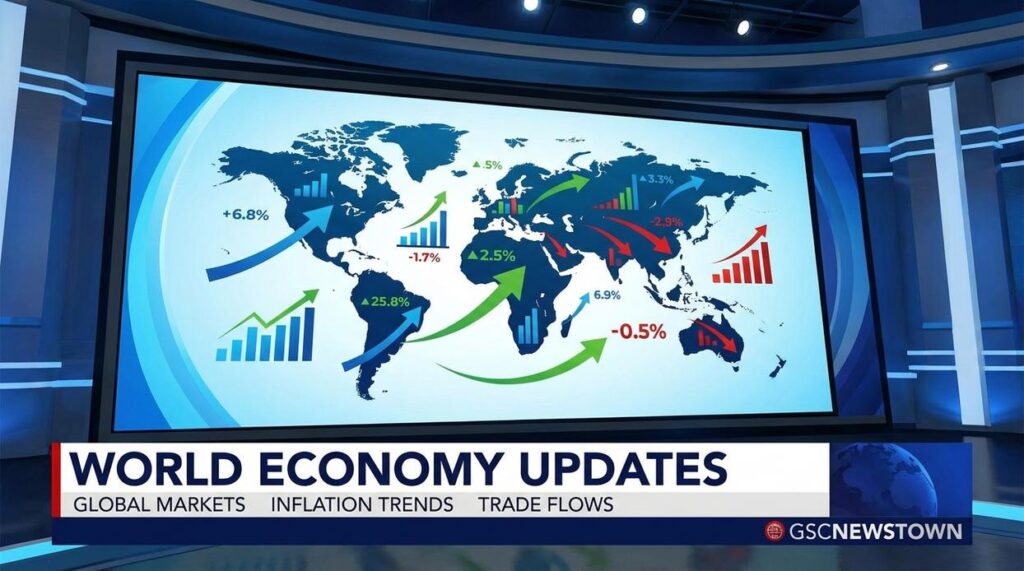
I’ve been tracking the global economy through one of its most confusing stretches in years.
You’re dealing with mixed signals everywhere you look. Inflation won’t quit in some sectors while others are cooling off. Supply chains are still acting weird. And geopolitical tensions keep throwing curveballs at markets.
It’s hard to make clear decisions when the data points in five different directions.
That’s why I put together this briefing. I wanted to cut through the noise and focus on what actually matters for your business or portfolio right now.
World economy updates gscnewstown tracks the economic trends that have real impact. Not the headlines that sound dramatic but don’t move the needle. We stick to hard data and what it means for people making decisions with real money on the line.
This article gives you a straight overview of the forces driving markets today. I’ll cover what’s happening with supply chains, where investment trends are heading, and which economic signals you should actually pay attention to.
No fluff. Just what you need to know to stay ahead right now.
Inflation and Interest Rates: The Global Tightrope Walk
Central banks thought they had this figured out.
Raise rates. Cool demand. Watch inflation fall back to target.
Simple, right?
Except it’s not working out that way. And honestly, nobody seems completely sure why.
I’ve been watching inflation numbers for months now, and here’s what’s strange. Despite some of the most aggressive rate hikes we’ve seen in decades, prices in major Western economies just won’t budge the way economists predicted.
The Fed keeps saying rates need to stay “higher for longer.” Meanwhile, the European Central Bank just cut rates again. Two of the world’s biggest central banks are moving in opposite directions.
Some analysts say this makes perfect sense given their different economic conditions. Others think one of them is making a serious mistake. The truth? We won’t know for sure until we see how this plays out.
What we do know is this affects your wallet right now.
Mortgage rates are sitting at levels we haven’t seen in years. Companies are putting off big investments because borrowing costs too much. That means fewer jobs and slower wage growth down the line.
But here’s where it gets tricky. The data we’re getting is mixed. Labor markets look strong in some reports and weak in others. CPI figures keep surprising people in both directions.
I can’t tell you exactly when rates will come down or if inflation will finally break. Anyone who claims they know for certain is lying to you.
What I can tell you is what to watch. Pay attention to the monthly jobs reports. Watch the CPI releases. These numbers will tell central banks what to do next, which means they’ll tell you what’s coming for your borrowing costs.
For more context on how these shifts are playing out globally, check out world business gscnewstown coverage.
The reality is we’re all learning as we go here. Central bankers included.
Geopolitical Tensions & The New Reality for Supply Chains
You’ve probably noticed your grocery bill creeping up.
Or maybe you ordered something online and it took twice as long to arrive as it used to.
That’s not random. It’s the new normal.
Some economists will tell you this is temporary. They say geopolitical tensions always blow over and supply chains bounce back. Just wait it out, they say.
I wish that were true.
But here’s what I’m seeing from Chattanooga and across the country. The old playbook doesn’t work anymore.
Key Flashpoints
Trade disputes aren’t cooling down. They’re spreading.
The U.S. and China keep adding tariffs. Europe’s caught in the middle trying to protect its own interests. And every time tensions spike in the South China Sea or the Middle East, trade routes get disrupted.
Companies can’t plan around this stuff because it changes every few months.
The Shipping Crisis 2.0
Remember when shipping containers were stuck at ports during the pandemic? We’re dealing with a different version of that now.
Maritime freight costs jumped again this year. Not pandemic levels, but high enough to hurt. When it costs more to move goods across oceans, those costs show up in what you pay at the store.
It’s simple math (even if nobody wants to admit it).
From Just-in-Time to Just-in-Case
Here’s where things get interesting.
Businesses are done pretending they can rely on global supply chains that stretch halfway around the world. I’m watching companies bring production closer to home. They call it near-shoring.
They’re also working with multiple suppliers instead of putting all their eggs in one basket. It costs more upfront. But when your single supplier in Southeast Asia shuts down because of a regional conflict, you’re glad you have backup options.
This shift to world economy updates gscnewstown covers regularly shows companies choosing resilience over efficiency. That’s a big deal.
Energy Market Volatility
Oil and natural gas prices swing wildly now.
One week Russia threatens to cut supplies to Europe. The next week there’s a drone strike on Saudi facilities. Prices spike, then drop, then spike again.
Businesses hate uncertainty more than they hate high prices. At least with high prices you can plan. With this volatility, you’re just guessing.
And when energy costs bounce around, everything else does too. Transportation, manufacturing, heating your home. It all connects.
Look, some people think I’m being pessimistic about this. They point to periods of stability and say things aren’t as bad as I’m making them out to be.
Maybe they’re right in the short term.
But the pattern is clear. Geopolitical tensions aren’t going away. Supply chains built for a peaceful, predictable world don’t work when the world isn’t peaceful or predictable anymore.
Companies that adapt will survive. The ones that don’t? They’ll keep getting blindsided every time something happens halfway across the globe.
That’s the reality we’re dealing with now.
The AI Boom: Fueling Growth Amidst Uncertainty
Have you noticed how every earnings call now mentions AI?
It’s not just tech CEOs anymore. Banks, retailers, manufacturers. Everyone’s talking about it.
But here’s what I want to know. Is this real growth or are we watching another bubble inflate?
Some economists say we’re overreacting. They point to the dot-com crash and warn that we’re making the same mistakes. They argue that AI valuations have gotten way ahead of actual revenue and that a correction is coming.
And you know what? They might be right about some companies.
But here’s where I disagree with the bubble narrative.
The money flowing into AI infrastructure isn’t speculative. It’s real capital going into real things. Semiconductor fabs in Arizona. Data centers across the Midwest. Power grid upgrades to handle the load.
According to world economy updates gscnewstown, AI-related sectors contributed nearly 0.8% to GDP growth in major developed economies last year. That doesn’t sound huge until you realize most economies grew around 2% total.
Think about that for a second.
One sector accounting for almost half of all growth? That’s not normal.
The infrastructure spending alone tells you something’s different this time. Companies poured over $200 billion into AI-enabling hardware in 2024. Not software. Not services. Physical chips and buildings.
That’s the kind of investment you make when you believe something’s here to stay.
Now let’s talk about what this means for jobs. Because this is where it gets complicated.
Corporate productivity is up. Way up. Companies using AI tools report efficiency gains of 20 to 40% in specific workflows. That’s showing up in profit margins.
But the labor market? It’s shifting faster than most people expected.
Some roles are disappearing. Others are changing so much they’re barely recognizable. And new positions are popping up that didn’t exist two years ago.
Is your job safe? Honestly, that depends on what you do and how quickly you adapt.
The real question isn’t whether AI will change work. It’s already happening. The question is whether the new jobs being created will pay as well as the ones being transformed.
So are we in a bubble?
Here’s my take. Some AI stocks are absolutely overvalued. When a company with no revenue trades at a $10 billion valuation because they mentioned AI in a press release, yeah, that’s bubbly.
But the underlying technology? The infrastructure? The productivity gains?
Those are real. And they’re not going away even if some stock prices come back to earth.
The business news gscnewstown coverage I’ve been following suggests institutional investors are getting more selective. They’re moving away from pure-play AI hype stocks and toward companies with actual AI-driven revenue.
That’s usually a good sign. It means the market is maturing.
Emerging Markets: A Story of Divergence
You’ve probably heard that emerging markets are either booming or busting.
The truth? Both things are happening at the same time.
I’ve been watching capital flows into developing economies, and what I’m seeing isn’t a single story. It’s two completely different worlds operating side by side.
The Winners and the Strugglers
Vietnam and India are on fire right now. Manufacturing is shifting there faster than most people realize. Companies want alternatives to China, and these countries are ready.
Meanwhile, countries like Argentina and several African nations that depend on commodity exports? They’re fighting headwinds.
The difference comes down to what you’re selling and who owes what.
Here’s what most coverage misses. Everyone talks about emerging markets like they’re one thing. They’re not. A tech manufacturer in Southeast Asia has nothing in common with a copper exporter in South America (except maybe the label we stick on them).
The dollar situation makes this worse. When the US dollar strengthens, countries that borrowed in dollars suddenly owe more in their local currency. Their import bills go up too.
That hits commodity exporters hardest because they can’t just pivot to something else.
But tech-forward economies? They’re attracting serious money. Foreign direct investment is pouring into places with young populations and governments that actually reformed their business regulations.
I’m seeing specific opportunities in Southeast Asian manufacturing hubs and select Indian tech sectors. The world economy updates gscnewstown regularly, and the pattern is clear.
Capital follows infrastructure and demographics. Not promises.
Navigating the Economic Landscape Ahead
You now understand the forces shaping our economy right now.
Inflation keeps pressuring your wallet. Geopolitical tensions shift without warning. AI is changing how businesses operate. And emerging markets are taking wildly different paths forward.
The challenge? None of this is settling down anytime soon.
The economy stays in flux. What worked last quarter might not work next month. You need to stay alert.
Here’s the thing about making smart decisions: you have to cut through all the noise. Focus on what actually moves markets and affects your money.
That’s where world economy updates gscnewstown comes in. We break down these trends as they happen so you can act with confidence instead of guessing.
The global picture keeps shifting. Your next step is simple: keep reading and stay informed.
When you understand what’s coming, you can prepare for it.
